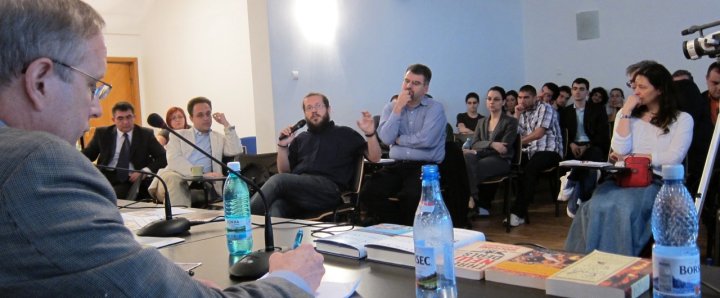
- Greg Rehmke in Bucharest : The Three Paths to Economic Freedom (March 29, 2006)
March 29, 6.30 PM: Gregory Rehmke holds the conference The Three Paths to Economic Freedom: Trade, Investment and Migration at the Opera Centre II – 2 Dr. Staicovici st, 2nd floor, Eleutheria Foundation, at 6.30 PM. Free entrance.
Greg Rehmke is a programme director at Economic Thinking. Throughout his activity ge gas created educational programmes for The Free Enterprise Institute and The Reason Foundation, and recently for The Foundation for Economic Education. He occupied the chairman position for the Knowledge Network Foundation and co-authored the software program Solutions. Gregory Rehmke is a member for the academic board of Mackinac Center. He is the author of more than a hundred articles on public policy, dedicating his entire career to promoting a liberal principles based market economy.
- Nozick – The State of Nature (November 23, 2007 Workshop)
In Anarchy, State, Utopia Nozick asserts 3 ideas: (1) Through an invisible-hand process, social order inevitably evolves from the state of nature to the minimal state. (2) This process and the minimal state are not illegitimate. (3) Any state that is more than minimal is illegitimate. The road from the state of nature to the minimal state has two median stages: the dominant protection agency and the ultraminimal state. In Chapter II Nozick shows how the state of nature leads to a dominant protection agency in a given geographical area.
Let us test his arguments. (Ionut Sterpan presents)
To read before the workshop: [NOZICK Robert 1974] Anarchy State and Utopia, Padstow Cornwall, T.J. Press Ltd. 1992, Chapter II.
Handouts:
Key terms: state of nature, dominant protection agency, ultra-minimal state, minimal state.
- Sztompka – Civilizational Competence ( November 30, 2007 Workshop)
In the essay Civilizational Competence: A Prerequisite of Post-communist Transition Piotr Sztompka explains post-communist transition through the concept of civilizational competence, while outlining the conditions which led to the emergence of the civilizational incompetence in the communist regimes of Central and Eastern Europe. (Aura Matei presents)
To read before the workshop: [Piotr Sztompka 1992] CIVILISATIONAL COMPETENCE: A PREREQUISITE OF POST-COMMUNIST TRANSITION
Reading notes: Sztompka, Civilizational Competence. Reading notes
- Jack Knight – Institutional Emergence (December 6, 2007 Workshop)
Unlike the functionalist theories of social selection, of equilibriums, or of selection within the institution market, Jack Knight proposes a new explanation in which the active factor is the strategic conflict between actors on distributive benefits resulting from the changes in various rules and norms.
To read before the workshop: Jack Knight Selection, Bargaining Theory of Institutional Change, Chapter 5
Handout: Handout Jack Knight, Institutions and Social Conflict
- Stevene Pinker – political options and human nature theories (December 14, 2007 workshop)
In the chapter about politics in “The Blank Slate”, Steven Pinker describes intellectual conflicts between the left and right and points out that they lead, largely, to a different theory about the human nature. The Left usually takes on a Utopic Vision, by which human natures is supposedly infinitely adaptable, whereas the Right adopts the Tragic Vision, which assumes human nature to be fixed and possesses a multitude of negative characteristics such as selfishness or violence tendency.
In this century’s old dispute, socio-biology and evolutionary psychology sparked controversies after providing scientific evidence for the Tragic Vision. Evolutionary psychology is not political in itself, some pieces of evidence undermining Right’s fundamentals (e.g. optimism in the capacity of some evolved individuals to endure a hunter-gatherer life and to pursue their own interests in the modern world. (Vlad Tarko presents)
To read: Steven Pinker – The Blank Slate. Politics. (selections)
Handout: Handout – Pinker, The Blank Slate. Politics
- A short economic history of humanity 10000 BC – 2100 BC Robert E. Lucas (December 21, 2007 workshop)
What is and why is economic growth important? What is the role and nature of “The Industrial Revolution”? Human population and income inequality. What are the causes of sustained economic growth registered in the past 200 years? Some alternative hypothesis: nature, culture, institutions, luck. Causes for the persistent differences in per capita income among the countries. Public policy influence: what matters and what does not in the sustained growth of standards of living. 21st century scenarios. (Gabriel Mihalache presents)
To read: Robert E. Lucas Jr. – The Industrial Revolution: Past and Future
- Herbert Hart – Are there any natural rights? (January 18, 2008 workshop)
Hart asserts that if there are any moral rights at all, there is at least one fundamental natural right: the right to liberty. This right has 2 characteristics: (1) all people capable of choice have it, (2) is not generated by the voluntary action of people. The argument arises from the differences among rights, obligations, freedom. This means that having a right involves the moral justification for limiting the freedom of other people. This moral argument can be: (1) particular, deriving from special transactions among individuals, such as promises, authorizations and mutual restrictions (in the case of political rights) added to family relations and special permissions, and (2) general, which asserts the equal principle of all people to be free in the absence of any particular condition that would limit someone else’s freedom. (Laurentiu Gheorghe presents)
To read: Herbert Hart – Are There any Natural Rights?
- Young& Block – destroying the public school system (January 25, 2008 workshop)
Young and Block plead for private education only. In Enterprising Education: Doing Away with the Public School System’ they reject 3 basic arguments for public education: (1) education is a necessary condition for democracy, (2) the market cannot offer everyone access to quality education, (3) due to externalities, it’s more efficient that education should be provided by the state than through the market. How do these arguments unfold and how are they rejected? (Costel Stavarache presents)
To read: Enterprising Education: Doing Away with the Public School System
- W. Buckley: Conservatory education (February 1, 2008 workshop)
What sort of education can better serve a liberty culture? What is the link between the educational content and the institutional system through which it is delivered? The conservatory thesis states that freedom from tradition, proclaimed by socialists (which asserts the beginnings of the social engineering project) is impossible. The argument is supported through the bibliographic background of W. Buckley Jr., the founding father of ‘National Review’, Michael Polanyi and Alan Bloom, The Closing of the American Mind’. (Mihai Neamtu presents)
To read: Buckley: The Aimlessness of American Education
Buckley: The Trojan Horse of American Education
Buckley: Today We Educated Men
- Representativeness. Combining individual preferences for collective action (February 8, 2008 workshop)
How would an original constitution look if it enabled individuals that value freedom to keep it , at the same time finding a solution to combining their preferences in a single, efficient collective action? What methods can best represent the preferences of the members of the community? Which representative model is compatible with the liberty values? (Andrei Trandafira presents)
To read: Andrei Trandafira – Introducere
Andrei Trandafira – Representation. Research fragments
- What are social acts and where do they come from? (February 15, 2008 workshop)
We attached a few texts as a starting point for the workshop:
The first is a short fragment from ‘Human Action’ by Ludwig von Mises in which we find a description of the classical anti-sociologic position – the idea that there is no social act independent of the individual’s desires/ wishes; society is only an association of individuals; it exists because collaboration and the division of labour is in everyone’s best interest.
The second text in the introduction to ‘Man and People’ , Ortega y Gasset’s meditation on the fundamentals of sociology. This text highlights the limits to Mises’ perspective and outlines the fact that, in order to avoid Durkheim mysticisms of a ‘social soul’, it is not necessary to adopt the extreme associationism proposed by Mises. There are social acts, like the way we greet each other, that cannot be reduced to the individual’s interests. Gasset’s key point is that social acts per se, which do not come down to individual interests under any circumstance, are absolutely irrational. The vast majority of habits fall into this category.
The third text, a fragment of the first chapter of Meme Machine by Susan Blackmore offers an explanation. How come there are so many irrational social acts? People imitate one another. The cultural items transmitted through imitation are called ‘meme’. The idea is that the utility of a meme (an idea, a fashion, a set of social norms, etc.), i.e. to the extent which it’s in the individuals’ interests, it’s only one of the factors that influence the ability of a meme to spread, to ‘infect’ the minds of people and to influence their behaviour.
The fourth text is a fragment from the chapter Redesigning Morality from ‘Darwin’s Dangerous Idea’ by Daniel Dennett. It shows why this is inevitable. The utopic ideal of perfect rationality is practically impossible, so all we can do sometimes is to imitate others, without knowing for sure that what we emulate is good. There’s a banal example to which there is no optimal rational solution – any solution is arguable. Such cases are in fact the norm.
The last text, the article „Better than Rational: Evolutionary Psychology and the Invisible Hand” written by Leda Cosmides and John Tooby, shows why the variability of culture is yet not unlimited. The same problem of the computational intractability emerges not only on a cultural level, but also biologically. A general, unbiased rationality would not be able to deal with concrete problems; it is for this reason that natural selection endowed us with specific cognitive mechanisms highly adapted to solving particular problems, including those in the social area. This means that, according to the context, we are genetically predisposed to become influenced by certain things and to prefer some things to others; not all memes have equal chances of spreading, though. There’s one more detail: the problems our brains are adapted to solving are current problems from the stone age! (Vlad Tarko presents)
Texts: Mises, Gasset, Blackmore, Dennet, Cosmides & Tooby.pdf
- What hinders the influence of liberty ideas? (February 22, 2008 workshop)
Keynes wrote that ideas, either right or wrong, are stronger than one might think. ‘Practical men who believe themselves to be quite exempt from any intellectual influence, are usually the slaves of some defunct economist. In this view, people exaggerate the power or influence of particular interests in particular circumstances on social changes, and undermine the importance of ideas. What would practical men answer to that? They might say that Keynes is dead for too long a time to be worth investing any resource in ideas. In other words, there is a wide a gap between the victory of ideas and its influence on history. Or maybe it’s not the ideas of social scientists that drive changes, but that interest groups pick what they like from a big pool of anonymous researchers.
Instead of a particular text, on Friday we shall focus on the more general problem directly concerning our activity: what are the structural barriers that a pro-liberty think tank faces? The aim of the workshop is to build a map or a list of hurdles that hinder the influence of liberty ideas.
- Jan Winiecki – the interaction of formal and informal institutions in explaining the transition (February 29, 2008 workshop)
The article looks on the process of post-communist transition, from an institutional perspective. The author stresses that resources play a secondary role in explaining the transition, as opposed to the importance of an institutional framework that facilitates or hinders economic development. Different results owe to differences in the institutional construction, and more importantly, to differences in what the author calls civilizational fundamentals of liberty, law, order and trust. The main thesis is that these fundamentals are the legacy of our pre-communist past. Thus, the success or failure of the transition is accounted for by the pre-communist legacy, by the existence or the absence of the afore mentioned fundamentals. (Aura Matei presents)
To read: Jan Winiecki – Determinants of Catching Up or Falling Behind
- Gordon Tullock: Edge of the Jungle (March, 7 2008 workshop)
Tullock’s research program explains both the cooperative behaviour and the coercive behaviour through the selfish interest of individuals (or the ‘individual reasoning’). The text also points to Darwin’s theory. Tullock describes a series of impersonal biological and social mechanisms that generate order/ induce cooperative behaviour and shows why the interest of the strong individual will not always act against that of the weaker one. He first explains the way those mechanisms work in the jungle, in communities that do not have a special construct to maintain order and enforce the rules of cooperation. Then, based on the same assumptions and mechanisms, he explains how civilized societies maintain order, how these societies possess that construct. It is worth noting that the jungle-civilization pair of opposites does not correlate with the anarchy-state pair. (Ionut Sterpan presents)
To read: Gordon Tullock – Edge of the Jungle
Handout: How selfish interest and natural selection induce and limit cooperative behaviour
- Ludwig von Mises: Minimum wage (March 14, 2008 workshop)
Mises’s text from ‘Human Action’ shows the negative effects of a raise in the minimum wage, a dear subject to all labour unions. This raise produces unemployment, while the unions call for violence and violates property rights. The raise of the minimum wage is an artificial rise (above the equilibrium mark) in the price for labour and is part of the larger socialist-interventionist state measure to control the prices on the market. When the good becomes too expensive, it doesn’t sell; so happens on the labour market, hence the unemployment. Unskilled workers, non-union members, and those whose work is not worth a minimum wage take the toll on this artificial rise in the price for labour. A young man creating value of 400 RON would not get hired for the minimum 500 RON wage. Mises finds common grounds between trade unions and Ku Klux Klan, in respect to their call for violence. They reach their goal in coercing employers to raise the worker’s minimum wage. (Costel Stavarache presents)
To read: Minimum Wage Rates, excerpt from Mises, ‘Human Action’
- The origins of human society (March 21, 2008 workshop)
The selection is from ‘Origins of Virtue’ by Matt Ridley, chapter 9, ‘The Source of War’. The previous chapters (2-8) describe just about the same arguments used by Tullock in his text which was presented by Ionut two weeks ago. This chapter focuses on the less desirable consequences of the sociability of people: xenophobia, war, and the spread of irrational beliefs (religions, Communism, Nazism, etc.)
Only by understanding how such phenomena occurred through the natural selections can we establish the factors that are the cornerstone of human society. Briefly, why is there a human society and not scattered families (like, for instance, gibbons and gorillas)? Man is a challenge to biology because human society does not resemble other animal societies, and the factors that explain the formation of animal societies are not enough to explain those of humans. What is, then, amiss? What’s more: in the animal society, the primary concern is to have as many descendants as possible – all other goals follow. Man might seem different, even though he too is an animal evolved through natural selection. On the other hand, human society is challenge for economy too: if we were to focus only on the ‘positive’ agents (such as division of labour) and name them the cause for society, we’d have an incomplete picture with social phenomena mysterious and inexplicable.
Our text is at the border between biology and economy, and it asserts that at the origin of all social phenomena which cannot be accounted for solely by selfish/ rational behaviour of individuals, be it cooperative or violent, there is one common feature, meaning the propensity of humans to imitate one another and to respect general agreements. The book ‘The Origins of Virtue’ is the popularization of evolutionist psychology, a domain which contends for the place of fundamental paradigm of all social sciences. (Vlad Tarko presents)
To read: Matt Ridley, The Source of War
Handout:
Reading Note on Matt Ridley’s The Source of War
- The Church and Politics (March 28, 2008 workshop)
The decision taken by the last Orthodox Church Council/ Synod allows priests to run for office in the local council elections. Given that local councils are institutions of the state, what are the implications of additional formal representation of the Church’s interests in such institutions? Who would profit from the nationalization of the Orthodox Church? Who would profit, and why, if, conversely, there was civic action towards the implication of the Church independent of the state’s institutions? (Mihai Neamtu presents)
To read: Hotnews Debate: Constantin Stoica, Horia Roman Patapievici, Radu Preda
- Axelrod: Evolutionary Stable Strategy (April 11, 2008 workshop)
Can we get evolutionary stable strategies (ESS) from repeatedly apply the prisoner’s dilemma (PD) within a population? Axelrod says so, provided we introduce a penalty strategy for those who fail to punish defectors (breaking of norms/ non-cooperation). Boyd and Lorberbaum disagree and say that the tit for tat strategy is easily reversible (makes the transition from cooperation to non-cooperation smoother) and so unstable in real life situations. Skyrms asserts that theoretically it is possible as long as ESS is adaptively acknowledged. Don’t be disheartened by the maths behind it; the idea is that stable evolutionary situations can emerge in order to automatically block a population is a self-imposed cooperation situation. (Laurentiu Gheorghe presents)
To read: Axelrod 1986 – An Evolutionary Approach to Norms
Optional: Boyd and Lorberbaum 1987 – No Pure Strategy is ESS in Repeated PDs
Skyrms 1994 – Darwin Meets the Logic of Decision Correlation in Evolutionary Game Theory
- Hidden taxes (April 18, 2008 workshop)
The operating costs of the state. The concept of hidden taxation. Listing all the visible taxes and an attempt to calculate the sum.
What is money spent on? What’s the budget’s structure? What explains the structure? Is it justifiable? What is the mechanism through which inflation pick out of the private agents’ pockets? What about the deficit?
How custom fees affect consumers.
Overregulation forces economic agents to pay ridiculous sums of money for accounting operations.
Overregulation forces economic agents to pay ridiculous sums of money for legal operations.
What is the link between taxes and a rise in the price of goods and services?
Taxation and regulation variation cost: raises entrepreneurial risk, distorts price signals on the market.
Services without licence / deemed illegal is taxation; it translates in the deprivation of fruitful trade which do not damage third parties.
Monopoly of certain sectors is taxation. The possibility of making trade with potential, unlicensed suppliers is removed.
Is it morally correct not to pay taxes?
- The after-life (May 9, 2008 workshop)
“We do not know now God or Heaven. We cannot know. Not only do we face uncertainty about God, we also have the feeling of existential insecurity: we could die at any moment, something bad might happen any time. But, in case there is life after death, the perspective changes and we will learn how things truly are. If we go to Heaven, all uncertainty and insecurity will vanish.” Sounds good, right? Yes, but things may be worse than they seem. You are invited to an open conversation about reasonable expectation we could have regarding life after death. The text is a compact transcription of a dialogue I had with Horia Terpe Tuesday, 29th of April, under the auspice of Easter holidays and the news about our friend, Diana Costea. (Ionut Sterpan presents)
To read: Ionut Sterpan – Afterlife
Optional:
Ionut Sterpan – Afterlife is not special
- Market Socialism (May 16, 2008 workshop)
Is it possible for a community to pursue traditional Socialist objectives using tools that aren’t traditionally associated with Socialism? The idea that income inequality is an inevitable by-product, a price paid for economic efficiency, is frequently part of the verbal, informal component of introductory economic courses; what the formal economic theory fails to explain is this exact inference. The first theorem of wellbeing and the Coase theorem are representative and traditional examples which identify sufficient conditions for economic efficiency achievement under specific circumstances. In the models that demonstrate these theorems there is a clear association between efficiency and distribution: informally, efficiency comes when resources are put on the market, regardless of whom does this. Market Socialists propose forms of institutional and industrial organization based on profit and competitive markets which try to reach certain social goals (for example, a better income distribution). Is their proposition for using contemporary economic theory (including the mechanism design literature, information and contract economy, etc.) to make a better economic and politic system credible? (Gabrile Mihalache presents)
To read:
Post-Lange Market Socialism: An Evaluation of Profit-Oriented Proposals
- Robert E. Anderson: Privatization: Just sell it (2) (May 30, 2008 workshop)
Anderson’s text tells us why privatization is important in the poor countries and it shares a few sound principles of a successful privatization. The author believes that privatization is beneficial if 100% of the company is sold by the government, if it’s open to all investors, both foreign and national, if the government does not impose extra regulations after the privatization, if the competitors are selected through the highest price criterion, and if the government doesn’t finance the privatization with a loan. We will see the reasons why these principles have rarely been put into practice. (Costel Stavarache presents)
To read: Robert E. Anderson: ‘Privatisation: Just sell it’
- From informal social rules to formal institutions (June 13, 2008 workshop)
Vlad Tarko
The main psychological ingredient that enables social organization is trust. When trust is present, physical threat is not necessary in order to guarantee agreements, and trades are mutually beneficial. Aggression plays a role in persuading someone to accept to do something that’s not in their interest. Thus, in the absence of trust, we cannot distinguish between a voluntary trade and a power relationship.
In the case of small groups of people (hundreds maximum) trust networks can be created through direct interaction. This is how human society have worked for more than 90% of mankind history, until approximately 10,000 years ago, when due to the discovery of agriculture, communities were able to flourish. Our social instinctive feelings, such as the feeling of equity, have evolved in the primitive societies, being a good way to tell free riders or scams apart in small groups. To some extent, these social feelings create wrong intuitions about today’s world; beyond the instinctive call to xenophobia which we have discussed in a previous workshop, the most significant phenomenon is the conflict between the individual freedom to act without causing harm to someone else and the equity feeling. Individual actions which cause no harm may seem instinctively unjust because they result in inequality.
In the case of large groups, trust among different participants cannot occur directly; mediators are needed, or in extremis, formal rules and institutions (governments). Imposed formal institutions are good when the result is trust among strangers. The transition from informal institutions to formal ones shows the transitions from “exchange among friends and family in a small community to exchange among strangers in a large community” (Shermer). Problems which a society with many people has to solve (Diamond):
- Solving and preventing conflicts between individuals
- Taking decisions related to public issues
- Overcoming barter -> introducing money -> monetary system issues
- High population density -> insufficient resources -> the need for trade
Our social tribal intuitions do not offer suitable solutions to these problems, on the contrary, they suggest:
- The necessity of forcefully imposing a single moral system
- Interference in the private sector (everything is public
- Disapproval of the interest concept, of middlemen, call for inflation
- Mercantilism and protectionism (rejection of free trade)
Historically, state did not emerge as of necessity or voluntarily, but because of aggression: either tribes have united to better withstand external threats, or one of the tribes conquered their neighbours and became more powerful and large. Well-documented study cases: External threat: Cherokee Confederation (18th century), The making of the United States of America (18th century), German unification (19th century). Through conquest: Zulu state (18th century), Polynesian states (18th-19th centuries), the Aztec and Inca Empires (15th century), the Roman and Macedonian Empires. Until now our intuitions led to the development of not so efficient formal institutions, based on excess of authority – something which Jared Diamond calls kleptocracies:
Considerations of conflict resolution, decision making, economics, and space thus converge in requiring large societies to be centralized. But centralization of power inevitably opens the door—for those who hold the power, are privy to information, make the decisions, and redistribute the goods—to exploit the resulting opportunities to reward themselves and their relatives. To anyone familiar with any modern grouping of people, that’s obvious. As early societies developed, those acquiring centralized power gradually established themselves as an elite, perhaps originating as one of several formerly equal-ranked village clans that became “more equal” than the others. (Guns, Germs, and Steel)
Michael Shermer cites and critiques at least a part of what Diamond stated about the necessity of centralization:
„Large societies can function economically only if they have a redistributive economy in addition to a reciprocal economy. Goods in excess of an individual’s needs must be transferred from the individual to the centralized authority, which then redistributes to the individuals with deficits.”
This conclusion makes sense from a folk economic perspective, where we simply scale up the social structure of hunter-gatherers into that of consumer-traders. In fact, societies have done just this throughout history. While it is true that most societies included top-down solutions in the form of chiefdoms, kingdoms, monarchies, theocracies, dictatorships, and the like, in the last half millennium the development of diverse economic and political institutions has flipped back to bottom-up solutions. And we have not simply increased the size and number of hunter-gatherer institutions and rules; we have added entirely new categories of similarly modelled social institutions, which in turn have created the need for entirely new categories of rules.
In particular, democratic capitalism offers a bottom-up solution based on the guaranteed right of private property and a democratic vote as well as the free and fair trade between citizens in the nation and with citizens in other nations. […] The addition of the relatively new concept of property rights – which assigns the right and use of a commodity to someone with stipulated rules of conduct that are socially recognized and mutually binding among all members of the group regardless of the owner’s ability to physically (and convincingly) threaten aggression – are counterintuitive to our evolutionary instincts and therefore require constant vigilance. (The Mind of the Market)
The institution of private property seems to solve the 4 issues mentioned by Diamond. It is not a satisfying condition, but a necessary one.
At the workshop held this Friday, June 13, 4PM, I would like to discuss:
- Which are the other necessary formal institutions
- The way in which there is the implementation of needless formal institutions, whereas informal ones function very well (the topic discussed by Shermer in the attached text)
- In what way the establishment of formal institutions should take into account informal pre-existing regulations (Anglo-Saxon Law v. French Law)
- How formal institutions evolve
To read: Michael Shermer – fragment from The Mind of the Market
Jared Diamond – fragment from Guns, Germs, and Steel (optional)
- The problem with justice and the restitution of nationalized properties in Post-communist Romania (June 28, 2008 workshop)
A comment session on Emil Socaciu’s doctoral thesis “The problem with justice and the restitution of nationalized properties in Post-communist Romania”.
The discussion is on:
section 2.2 (Property rights and normal socialization),
section 2.3 (What is the moral value of a restitution) and
the conclusion section (What we’ve achieved).
- Film Screening – The Jack Bull (July 11, 2008 workshop)
Plot summary: The Jack Bull tells the story of Myrl Redding (John Cusack), a Wyoming horse trader who clashes with Henry Ballard (L.Q. Jones), a fellow rancher, after Ballard abuses two of Myrl’s horses and their Crow Indian caretaker, Billy (Rodney A. Grant). When a local judge throws out Myrl’s complaint, the war he wages to force Ballard to nurse the emaciated animals back to health escalates into a vigilante manhunt, murder, and the possible defeat of Wyoming’s bid for statehood. (Wikipedia)
The screening is TV out, no subtitles.
You may read a three page introduction in preparation to the topic of ‘taking justice in one’s own hands’: Nozick – Anarchy, State and Utopia, pp 54-56
- The relationship between freedom and security (October 10, 2008 workshop)
Saturday, 11 October is the International Day against Governmental Surveillance. There are protests as well; they come as a reaction from the people to some projects of legislative modification which enable governmental secret services to broaden their scope of action. These modifications are reactions to terrorist danger. The hot debate is made on the law about data from telecommunication services.
I will take this opportunity to go back to an old theoretical issue my CADI colleagues had on the relationship between freedom and security, and I will try to formulate this is general terms. The way this is usually tackled is from the perspectives of “right to a private area”, and the limits to rights which are being altered by the technological advances readily available to both the good and bad. Why is the right to a private area important? The first danger is the uncovering of certain things that the individual would rather keep secret. A bit of ‘institutional analysis’ reveals a more profound threat in competition.
Firstly, political competition. Our world as we know it, depends on the well-functioning of democracy, the balanced duel between those in power and the opposition. With the help of secret services, those in power will be able to discover their competitors’ strategies. If the tool secret services use is being consolidated and only available to those in power, the political opposition will be constantly weakened and controlled, in the detriment of the people.
Secondly, economic competition. If the telecommunication and internet services companies will be compelled by law to store the entire content of their clients’ data, this is will raise the cost of their services. But the cost will rise from another reason, as well. Facilitating the access of existing companies to the communications of other economic agents means providing them with the content of the business strategies made by other entrepreneurs and potential competitors.
On the other hand, what type of protection can we reasonably expect from a state with too narrow scope of action?
Ionut Sterpan presents
Special guest: Marian Zulean, CADI associate, Lec. Bucharest University, specialist in national security issues.
- The financial crisis (October 17, 2008 workshop)
Is the financial crisis a Capitalism phenomenon unattended to? Some might say agree and go on to link this belief with recommendations of massive government intervention on the financial market. Could it possibly be that the crisis erupted because of the government’s credit expansion policies? Could a new liquidities injection aimed to unclog the system cause even further harm? (Vlad Topan presents)
Leftist Libertarianism (November 1, 2008)
A political philosophy workshop prior to Hillel Steiner ‘s lecture on Wednesday at the Philosophy Faculty.
Presentors:
Kostea Vica and Ionut Sterpan
To read:
Barbara Fried – Left Libertarianism: A Review Essay
Vallentyne, Steiner, Otsuka – Why Left Libertarianism is Not Incoherent, Indeterminate, or Irrelevant
Tom Palmer – Review of An Essay on Rights
Hillel Steiner – A Critical Note on Nozick
The texts can be found on Biblioteca Electronica
- Left-libertarianism (November 1, 2008 workshop)
A political philosophy workshop before Hillel Steiner’s lecture, Tuesday, at the Philosophy Collage.
Presented by: Kostea Vica si Ionut Sterpan
To read:
Barbara Fried – Left Libertarianism: A Review Essay
Vallentyne, Steiner, Otsuka – Why Left Libertarianism is Not Incoherent, Indeterminate, or Irrelevant
Tom Palmer – Review of An Essay on Rights
Hillel Steiner – A Critical Note on Nozick
The texts can be found on Biblioteca Electronica
- The Status of Classical Liberal Move (November 7, 2008 workshop)
‘Status of the Classical Liberal Move: An Assessment in the Light of the Current Electoral Evolution. What is the meaning of the current electoral evolution in the USA and Romania and what are their implications on the strategies which the classic-liberal move follows.
Special guest: Dragos Paul Aligica.
- Three capital errors of libertarianism (November 14, 2008)
A new debate with Dragos Paul Aligica: Three Capital Errors(and Many Other Less Grave) of Libertarianism. The Strengths, Weaknesses and Future of the Libertarian Move‘.
- A critique to the consumer culture (November 21, 2008 workshop)
A workshop on the critical piece written by Sorin Cucerai on consumer culture. Present on Repeat. Meditation on the American Crisis‘.
- The Intellectuals and Politics (November 28, 2008 workshop)
‘The Intellectuals and Politics’. A Lecture held by Marian Panait, researcher at the Romanian Academy Institute of Philosophy.
- Student-Teacher Love Affairs (December 19, 2008 workshop)
Let us suppose we are in the board of directors of an autonomous university. Is there any rule that should be set in place regarding love affairs between professors and students? If so, how to be managed? But what about companies and the affairs between employers and employees? Does the lack of university autonomy change anything?
To read: Gigi Stefanov – Student-Teacher Love Affairs
Introduction by Andrei Trandafira.
- Philosophical discussion on trust in the web technology and the web platform (CADI, February 6, 2009, 16:00)
The web technology is at its peak. On one hand there are consistent demand for mechanisms to build confidence in the web architecture, in its services, and among users, and on the other, there is the danger of centralization, stagnation, homogeneity. One of the fundamental traits of the web technology is flexibility. The web is a generative technology, and this characteristic can be conditioned, or even cancelled by the need for trust/ confidence.
Kostea Vica presents.
To read: Kostea Vica – Trust and the Web Technology
Optional:
McGeer – Developing Trust on the Internet
Pettit – Trust, Reliance, and the Internet
- Discussion on the right to keep fire arms versus the right to forbid fire arms. (CADI, February 13, 2009, 16:00)
Last year, the Supreme Court of Justice made a decision against the restriction imposed by the authority in the District of Columbia regarding the possession of fire arms. Beyond the American constitutional dispute (see R. Posner In Defense of Looseness) what are the arguments for getting a licence to hold fire arms? Is there any relevant difference between the American background and the Romanian one?
Bogdan Glavan presents
To read: Bogdan Glavan – Legalizing Fire Arms
Optional: Listen to two radio shows cu Tom Palmer, Cato Institute, one of whom sued and won the case against DC.
March 14, 2008 (18:01)
Tom Palmer talks about the DC gun ban on Reporter’s Roundtable
March 12, 2008 (31:46)
Tom G. Palmer talks to the Washington Post about the DC gun ban.
- How and why does the scientific community thrive and what does society as a whole have to learn from it? (CADI, February 20, 2009, 16:00)
The scientific community is a special organization for several reasons:
- It’s an international organization, which moves beyond territorial, cultural, religious boundaries. Scientists are among the most nomadic people of today’s world.
- It’s been thriving for almost three centuries, going from a secluded group of eccentric peers (working outside and sometimes against the universities) to a community touching on all aspects of human life (and which is now part of the universities)
- It is completely decentralized; the decision centres are the scientific magazines whose reputation needs constant renewal (famous magazines of decades ago have perished), it has a fluid decision system which is in continuous renewal
- It does not have a uniform production system (research is made in universities, as opposed to research centres or the industry)
- It is based on a system opposed to that of intellectual property (scientists need to publish all, including partial results, due to the ‘publish or perish’ policy)
- It has a final goal to which all its actions concur: understanding the way all things work.
In short, the scientific community has many similarities with a democracy, common ground with corporations, with the economy; even though the resemblance is not perfect. This community interacts with the states and the industry, which affects (positively and negatively) the way it carries on its activities.
The question is what can we learn from the scientific community:
- Can we get ideas about to improve existent democracies? (Politically speaking, can the scientific community be considered as an example of functional anarchy?)
- Can we get ideas about how to improve corporate culture? (Managerially speaking, can the scientific community be considered a sort of multinational corporation with an extremely flexible hierarchic organization?)
- Can we get ideas about the law in economy? To what extent does the scientific community offer clues about how the industrial sector would look in the absence of patents and copyrights?
How and why the scientific community works?
-
The first workshop from the series – Right Wing Currents: Public Choice ( Thursday, February 26, 2009 )
The discussions have the next structure: 1. A brief description of the current. 2. The context of debate in which the current, the roots, the history of the movement with its authors and ramification, have appeared. 3. Presentation of the main studies. 4. The main thesis profoundly presented. 5. Critics. 6. Speculations regarding the value of the current, the political use, its future, its possibilities and its practical effects.
Presented by: Laurentiu Gheorghe
Lectures: Elinor and Vincent Ostrom – The Quest for Meaning in Public Choice
William Niskanen – My recent contributions to Public Choice
-
Naomi Klein, Capitalism and the Shock Doctrine ( CADI, Friday, 6 of March, 16:00 )
Disasters throw us temporary into a state in which it is easier for us to be manipulated. This is the “Shock Doctrine”, to engage in or to take benefits from whatever the shock looks like, in order to catch the power. The method may be found at the institutional level: the first shock, a natural disaster or a war, prepares the ground so that an elite can apply the desirable institutional system. Once the system is put to work, the dissidence is controlled through shock- therapy, like the torture applied to some opponents.
The main idea form, The Shock Doctrine. The Rise of Disaster Capitalism, which is the new bible for the people who disagree globalization, for left movements occurring everywhere, is to find historical situation where the method serves the capitalism: Pinochet in Chile, Sachs in Bolivia, Rumsfeld in Irak.
The strategy of this book consists in the association between the brutal and undemocratic elements in this situations and parts from Milton Friedman’s ideas. Milton Friedman and capitalist elites understood this philosophy of control and used it to implement an unpopular economic model.
1.To what extent the critics of corporatist capitalism are applied to simpler capitalism?
2.How relevant are the historical situations described by Naomi Klein for the spread of capitalism? To what extent the model can be applied to the 1989 moment?
3.Can we talk about conspiracies?
4.What makes this book successful?
5.What are the tools to help us observe the unpopularity of the capitalist model?
Presenter: Ionut Sterpan
Lectures: Naomi Klein – The Shock Doctrine. The Rise of Disaster Capitalism. Introduction.
Johan Norberg – The Klein Doctrine. The Rise of Disaster Polemics
-
The economic organization – political organization analogy ( CADI, Friday, March 20, 2009, 16:00 )
What can a political organization learn from an economic organization ? What they can’t afford to learn ? A discussion starting with the third chapter form the Phd Thesis of Dorina Mihaela Cucu. We announce that the Thesis will be officialy presented soon at the Faculty of Philosophy, Univesity of Bucharest.
Presenter: Dorina
Lectures: Dorina Mihaela Cucu – Chapter 3- The economic organization- political organization analogy, an extract from the PhD Thesis “ Efficacy or democracy ? The philosophical dilemmas of the political institutions role. ”
Optional:
-
Workshop from the series – Right Wing Currents: Entrepreneurial Theory ( CADI Friday, March 27 , 2009 )
The discussions have the next structure: 1. A brief description of the current. 2. The context of debate in which the current, the roots, the history of the movement with its authors and ramification, have appeared. 3. Presentation of the main studies. 4. The main thesis profoundly presented. 5. Critics. 6. Speculations regarding the value of the current, the political use, its future, its possibilities and its practical effects.
Presenter: Andrei Trandafira
Lectures: Andrei Trandafira – The entrepreneurial character of decision-making
-
Sources of the capitalist order (CADI, Friday, 3 of April, 2009, 16:00)
A discussion about the elementary in capitalism. What is the relationship between capitalism, individual autonomy and self-sufficiency? How did the currency taxation made it to grow the amount of commercial relations?
Presenter: Sorin Cucerai
Lectures: Sorin Cucerai – About capitalist order
-
Habitation in and out of communism (CADI, Friday, April 10, 2009, 16:00)
With the financial crisis as a background, caused mainly by mortgages policy, we can ask ourselves if there is any articulate conception about habitation in the ideology of every political regime.
Gabriela Bleabea gathers studies from Romanian philosophers, sociologists, anthropologists, architects, geographers and historians about institutions and ways of habitation in and out of communism.
We invite you to a discussion about property – habitation relationship, house policy, nationalization process, restitution, ways of justice and habitation ethics, with other close subjects like: neighbourhood, living in the countryside, working-class neighbourhood, bachelor houses, habitation of Rroma population, habitation in prison, in and out of communism.
Presenter: Gabriela Blebea Nicolae.
-
Workshop: The meaning of life ( CADI, Thursday, April 16 , 2009, 16:00 )
A philosophical workshop about meaning of life starting with a mix of lectures- The Book of Ecclesiastes, Immanuel Kant What is Enlightenment, Friedrich Nietzsche – Twilight of Idols and Tristan Tzara – Dada Manifesto.
Presenter: Vlad Tarko.
Lectures: Sensul vietii – Ecleziastul, Kant, Nietzsche, Tzara
Optional: Ionut Sterpan – A way to avoid iluminist criticism towards religious faith
-
Workshop: The right wing reconstruction ( CADI, Friday, May 8, 2009, 16:00 )
What are the chellenges for the XXI century meeting weastern world and capitalism ? How the right wing will use its double heritage, classic-liberal and conservative ? A discussion starting the epilogue of Right Wing Reconstruction, Valeriu Stoica and Dragos Paul Aligica.
Special guest: Dragos Paul Aligica
Lectures: Valeriu Stoica, Dragos Paul Aligica – Continuitate si schimbare. Despre doctrina politica a viitorului, dincolo de clisee. Extract form Stoica V. and Aligica D. P., Reconstructia Dreptei: între experimentul capitalist occidental si proiectul national românesc, Humanitas, Bucuresti, 2009.
-
Workshop from the series – Right Wing Currents: Chicago School and Monetarism (CADI, Friday, 15 may 2009, 16:00)
The discussions have the next structure: 1. A brief description of the current. 2. The context of debate in which the current, the roots, the history of the movement with its authors and ramification, have appeared. 3. Presentation of the main studies. 4. The main thesis profoundly presented. 5. Critics. 6. Speculations regarding the value of the current, the political use, its future, its possibilities and its practical effects.
Presenter: Radu Simandan
-
Workshop from the series – Right Wing Currents: Christian Democracy (CADI, Friday, May 22, 2009, 16:00 )
The discussions have the next structure: 1. A brief description of the current. 2. The context of debate in which the current, the roots, the history of the movement with its authors and ramification, have appeared. 3. Presentation of the main studies. 4. The main thesis profoundly presented. 5. Critics. 6. Speculations regarding the value of the current, the political use, its future, its possibilities and its practical effects.
Presenter: Costel Stavarache
-
Workshop from the series- Right Wing Currents: Evolutionary Psychology. The impact on political Philosophy (CADI, Friday, May 28, 2009, 16:00)
The discussions have the next structure: 1. A brief description of the current. 2. The context of debate in which the current, the roots, the history of the movement with its authors and ramification, have appeared. 3. Presentation of the main studies. 4. The main thesis profoundly presented. 5. Critics. 6. Speculations regarding the value of the current, the political use, its future, its possibilities and its practical effects.
-
Owing the extraterrestrial resources (CADI, Wednesday, June 3, 2009, 14:00 )
A discussion about limits of acquisition on extraterrestrial property. What is the legal frame de facto, what are its philosophical sources and how justifiable are them?
Special guest: Virgiliu Pop member of International Institute of Space Law, researcher at Romanian Spatial Agency and author of Who Owns the Moon? Extraterrestrial Aspects of Land and Mineral Resources Ownership, and Unreal Estate. The Men Who Sold the Moon.
Lectures: Pop, Virgiliu. Who Owns the Moon?: Extraterrestrial Aspects of Land and Mineral Resources Ownership. Springer, 2008 (pp. 1-8, 51, 62-64, 82-83, 122-126). A preview of the book is available on Google books.
Homesteading is likely to transform the lunar desert in the same manner as it transformed the 19th Century United States. Space is indeed a new frontier calling for individualism rather than collectivism, and its challenges need to be addressed with a legal regime favorable to property rights.” (Virgiliu Pop).
-
Workshop from the series- Right Wing Currents: Neo Conservatism (CADI, Wednesday, June 3, 2009, 14:00 )
The discussions have the next structure: 1. A brief description of the current. 2. The context of debate in which the current, the roots, the history of the movement with its authors and ramification, have appeared. 3. Presentation of the main studies. 4. The main thesis profoundly presented. 5. Critics. 6. Speculations regarding the value of the current, the political use, its future, its possibilities and its practical effects.
Presenter: Radu Cristescu
Lectures: Radu Cristescu – Note despre neoconservatorism
Optional: Neamtu, Mihail, coord. 2009. Dosar ID: Conservatorismul american. Idei in Dialog 53: 16-38
-
Reinventing Politics: Eastern Europe after 1989. Workshop with Vladimir Tismaneanu, Monday, 6 of July 2009, 17:00, Opera Center
When politics were entrusted by Constitution exclusively to the Communist Party, civilian groups have appeared truly out of the matrix of existent power. Here you should look for the disintegration germs of communist regimes in Eastern Europe. This is also the reason for the nonviolent changes of regime.
Vladimir Tismaneanu extends his explicative project started in 1991 to the last 20 years’ history. How important are the independent civilian structures in solving political problems?
-
Workshop Sociological legitimacy ways of capitalism (CADI, Friday, July 17, 2009, 14:00 )
The trust into a socio-economical system is sustained by the practical interests which governs its relationships and by how much sociological legitimacy it has.
Socialism entails a poor trust in the socio – economical system but has a good sociological legitimacy. Contrary, Capitalism entails a good trust in the socio – economical system but has a poor sociological legitimacy. Why?
A workshop with discussions about how the versions of socialism gave a direct answer to the spiritual need of a myth, and about ideas – religious or just potentially myth holders- that justifies, unspoken, the capitalism.
Presenter: Sorin Cucerai
-
Workshop from the series- Right Wing Currents: The juridical evolutionary way (CADI, Friday, July 31, 2009, 16:00 )
The juridical evolutionary way admits the conception of graduate growth of laws rather than laws being deliberate human creations. A conception like that seems to have conservative consequences. Although, Hayek, the most important follower of this conception, is a liberal author. How do the two dimensions of his conception, get on?
Presenter: Raluca Alecu and Dragos Bigu
Lectures: Gray, John. 1980.”F. A. Hayek on Liberty and Tradition”. J. of Libertarian Studies. Vol. 4, No. 2. (Spring): 119-137.
-
Workshop from the series- Right Wing Currents: Futurology and Anti – Alarmism (CADI, Friday, August 14, 2009, 16:00 )
The discussions have the next structure: 1. A brief description of the current. 2. The context of debate in which the current, the roots, the history of the movement with its authors and ramification, have appeared. 3. Presentation of the main studies. 4. The main thesis profoundly presented. 5. Critics. 6. Speculations regarding the value of the current, the political use, its future, its possibilities and its practical effects.
Presenter: Costel Stavarache
-
The Romanian Orthodox Church and Politics after 1989 (CADI, Friday October 9, 2009, 16:00 )
Can we talk about the special status of Romanian Orthodox Church given by Romanian State and its politicians? How much does the Church benefit from this, or is just the Cleric people who benefit?
How do the negotiations between Church and the state run? Is it necessary or rather damaging, a governmental department for dialogue between the State, on one side, and The Cults and State Secretariat for Cults, on the other side?
Why is The Romanian Orthodox Church such a “quiet“ institution? To what extent the lack of transparency is due to the inefficacy of this institution as a part of the civilian society?
Reflection on concrete situations, foundation of the Orthodox Episcopal Church of Covasna and Harghita also of the Archiepiscopal from Constanta, Teodosie Petrescu, the first active Hierarch from the modern history of The Romanian Orthodox Church against whom was disposed the initiation of criminal prosecution, comes to offer us an answer.
Presenter: Bogdan Duca, Graduated Theology and a postgraduate of Faculty of Political Science
Lectures: Gabriel Andreescu – Spre crearea unui stat ortodox roman?
Mediafax: IPS Teodosie, cercetat penal pentru luare de mita si complicitate la fals intelectual
-
Privatisation of marriage, Workshop, Philosophy Faculty, October 21, 2009
Both, people against same- sex marriages and those who agreed with it have a common proposal: the state must define marriage status through a unique formula. The daring solution is “marriage privatization”, which means to transfer the matrimonial union prerogative from the state to the civilian competing organizations, religious or secular. The economical analysis of law and the public, both choose the theory perspective (that shows why this pluralist system which allows a diversity of unions, eliminates further damaging unions for a third part, proved by a Court) which is impartial to ways of union, unlike status- quo.
This system will serve better liberty, equality, justice and will satisfy better the conservative necessity of synchronizing between legal formal treatment and social acceptance degree.
Philosophical analysis of new words meaning that develops naturally, seems relevant for the definition against same-sex marriage, that makes impossible on a semantic level the marriage for same-sex people.
Formally the argument against same-sex marriage comes till polygamy and marriage with inanimate objects; practically, the argument is weak because there is a special psychological value in the symmetric relationships. They argue for a structural system of liberty which, because of the psychological conjuncture, makes people prefer symmetrical relationships and that means, equality.
Presenter: Ionut Sterpan
Lecture: Sterpan, Ionut. 2009. Marriages between same-sex persons. A libertarian perspective. The New Magazine of the Human Rights 3/2009.
Reflections on text : Emanuel Socaciu – Additional Proofs and Objections
Constantin Vica – Marriage as an Institution of the State
Workshop organized by post- graduates from Philosophy Faculty and CADI, Wednesday, October 21.
-
Bloomington’s Institutional school and public choice theory form. Workshop with Dragos Paul Aligica (CADI, Thursday, October 29, 2009, 16:00)
Bloomington School became one of the most dynamic, well-known and productive institutional think-tank. But what is the combination between interdisciplinary theoretical approaches and empirical research, that made it successful?
Presenter: Dragos Paul Aligica
Optional:
-
International Relations between Church and Higher Education (CADI, Tuesday, November 10, 2009, 16:00)
To what extent is the higher education in Romania affected by religious confessions and how does the state – church relationship reflects on Theological education? Liviu Andreescu ends a research report on this topic. The accuracy of this research report gives us a hint about individual consciousness liberty.
Presenter: Liviu Andreescu
Special guest: Gabriel Andreescu
Lecture: Andreescu, Liviu 2009. The Expansion of Religious Manifestations in the Romanian Higher Education. Organisation, case studies, consequences. The New Magazine of the Human Rights 3/2009.
-
Capitalist order and its cultural tensions. Workshop with John Medaille and Sorin Cucerai (Faculty of Philosophy, Wednesday, November 25, 2009, 16:00)
The freedom of competing increases goods offer and labour force request needed for production and their allot. So, prices go down proportionally with work costs, and capitalism allows a continual growth for both production and consumption. But this is a positive spiral, says Sorin Cucerai and is fed by an artificial element, apparently hostile to the market, which is currency tax paying obligation. Is the state himself that forces people to take part on the market changes flow? Without the state, the spontaneous order would carry forward the psychological autarchic tendencies. In that way the individual searching for security, would link his life to a direct source of food, the ground. More than that, the constant offer renewal creates an insecurity feeling: once they lose the past goods’ acquisition value, personal history of the individual loses its meaning.
With a traditional organic preindustrial view, the theologian John Medaille revaluates this ideas form a general capitalist order critique. A system that forces the decreases of household goods value, that are still functioning, is a system that weaknesses one’s wealth. Likewise, a system that closes the individuals into such noisy diverse environment of their own desires, also lock them away from their spiritual vocation and profound needs, the relationship with nature, family and local community.
Is the criticism on consumption society justifiable? Is it applicable to capitalist order as it is? Is the spontaneous order incapable to sustain the capitalist system?
Presenter: Ionut Sperpan
Special guests: Sorin Cucerai, John Medaille
Lectures: Sorin Cucerai – Despre ordinea capitalista
John Medaille – The Tans-finite and the Trash Heap
Discussion will be held in English. Workshop organised by post graduates from Faculty of Philosophy, University of Bucharest and CADI.
-
Things that failed in today’s monetary system (CADI, Tuesday, December 15, 2009, 16:00 )
Today’s monetary system is largely described by fractional reserve institution, central bank’s legal monopoly (institution) to emit coin and the specific coin use restriction. Are all these institutions responsible for capitalist failure and liberal policy failure? How do they contribute to create business cycles? What are the alternatives?
Presenter: Claudiu Nasui
After workshop : ‘Cafeneaua Libertatii’at You Café.
-
How can murder be morally correct? Episode 1, Justice Class by Michael Sandel. CADI Workshop, movie projection, Wednesday, February 3, 2010, 16:00
How can a murder be perceived as morally correct? What will you do if you were to choose between 1. killing someone to save other five lives and 2. not doing anything but witnessing other five people dying, unless you act? What is the morally correct action to take? This is the hypothetical scenario presented by Michael Sandel in the opening of moral rationalism course form Harvard University.
When is the cannibalism morally correct? Sandel makes an introduction of philosophical principals borrowed from Jeremy Bentham, anbutilitarian philosopher. He discusses the following case: The famous 19th century law-suit of four sailors shipwreck. Nineteen days later, Capitan decides to murder the weakest of them, to provide meat for the rest, so they can survive.
Program: 16:15 – 17:15 Episode projection The Moral Side of Murder | The Case for Cannibalism
17:15 – 18:45 Discussion
-
Does human life have a price. Episode 2, Justice Class by Michael Sandel. (CADI Workshop, movie projection, Tuesday, February 16, 2010, 17:00)
Sandel brings out some contemporary cases that uses cost – benefit analysis to attach a price on human life. But there are objections about the utilitarian logic of happiness pursuit for as many people as possible. Can we make a sum and compare values using the same unit, like the coin? Ideas form J. S. Mills whom argues that the utilitarian rule is comparable to protecting rights and that utilitarian method distinguishes between inferior and superior pleasures. Sandel tests the theory by presenting three different pleasure sources: Hamlet, Shakespeare; Reality Show Fear Factor; Simpson Family.
Program: 17:00 – 18:00 Episode 2, Putting a Price Tag on Life | How to measure Pleasure
18:00 – 20:00 Discussion
-
Redistribution. Episode 3, Justice Class by Michael Sandel. (CADI Workshop, movie projection, Tuesday, February 23, 2010, 17:00)
Is taxing in redistributive purposes considered to be forced labour? Are we obligated to pay our taxes? How significant is the fact that most of the rich people owe their fortune to chance and inheritance? A group of libertarian students from Harvard explore some of the answers in front of Michael Sandel.
Program: 17:00 – 18:00 Episode 3, Free to Choose| Who Owns Me?
18:00 – 20:00 Discussion
After the Workshop, Claudiu Nasui invites us at Cafeneaua Libertatii in Big Mamou.
-
Extending public space, Reshaping private space (Workshop CADI, Friday , 5 of March 2010, 16:00)
The recent technologies from computers’ network, world wide web, to security cameras, lead to a public space enlargement, more precisely: information about persons that were, in the past, known only by a few (close friends and family), become, nowadays, available to anyone who has an interest in finding them. From the perspective of the classic-liberal theory, this enlargement raises some question, because the distinction between public and private plays an important role in the theory. For instance, Judith N. Shklar, in “Liberalism of Fear”, writes:
<<Liberalism … as a strictly political theory is not necessarily linked to any one religious or scientific doctrine, though it is psychologically more compatible with some rather than with others. It must reject only those political doctrines that do not recognize any difference between spheres of the personal and the public. Because of the primacy of toleration as the irreducible limit on public agents, liberals must always draw such a line. This is not historically a permanent or unalterable boundary, but it does require that every public policy be considered with this separation in mind and be consciously defended as meeting its most severe current standard.
The important point for liberalism is not so much where the line is drawn, as that it must be drawn, and that it must under no circumstances be ignored or forgotten. The limits of coercion begin, though they do not end, with a prohibition upon invading the private realm, which originally was a matter of religious faith, but which has changed and will go on changing as objects of belief and the sense of privacy alter in response to the technological and military character of governments and the productive relationships that prevail. It is a shifting line, but not an erasable one, and it leaves liberals free to espouse a very large range of philosophical and religious beliefs.>>
The way in which the liberal theory is applied in the new context is not evident. The public-private liberal distinction has meaning from the point of view of physical property’s rights, while the recent technological evolution is rather understood from the point of view of public-secret distinction, referring to information. The situation with which we are confronted is not as much about restricting the private property in favour of public property enlargement, as about the individual’s incapacity of maintaining, as they did until now, different identities adapted to a context or other of their lives. For instance, the employers take into consideration the Facebook photos of employee X, in which he is drunk at a party that had place last summer (photos posted by the employee X friends); assurance companies want to have access to your whole medical history ( which is supposed to be confidential); undemocratic governments are infiltrating in the social networks and are detaining the opponents before they can actually do something; democratic governments collect the citizens’ personal data in order to make the social protection and citizens’ safety more efficient, but they can’t guarantee that this data are not used (with or without the institutions’ agreement) for other purposes.
Paul Ohm, in “Broken Promises of Privacy: Responding to the Surprising Failure of Anonymization” argued that maintaining the private data confidential is, technically, impossible and unrealistic. The guarantee of the personal data’s privacy through contract may be a promise which is made in vain. As the public politics regarding the informational technologies have to also take in consideration this fact. And the idea of giving to people “copyright” over their personal data may not be the optimum approach.
What will be the problem if all information will be made public? James Grimmelmann, in “Accidental Privacy Spills” makes the following remark:
<<On a technical level, privacy and copyright are isomorphic problems. Information is to be shared with certain people and not with others. From this observation have come some interesting ideas. … But this overlap has unfortunate consequences, as well, because many people’s ethical intuitions cut very differently across these two problems. A technically consistent pair of responses to them may feel wildly inconsistent as a matter of right and wrong. If credit-card databases were trivially available on major BitTorrent trackers, how many people who now believe in file-sharing would demand a complete ban on BitTorrent?
The conventional distinction between privacy and copyright is that the information is used in different ways. Copyright violations tend to involve many individuals violating the rights of a few large entities; privacy violations often reverse this picture. This asymmetry makes it possible to enforce privacy protections. You could stop the NSA in its tracks by prohibiting them from maintaining the wrong sort of database. You could go out, find major commercial violators, and slap them with big fines. The traditional privacy violator invades privacy wholeseale; “copyright infringement” today often connotes something much more individualistic.>>
Friday, 5th March, Vlad Tarko and Constantin Vica talk about the possible, negative consequences of the impossibility of maintaining personal data confidential- confidential as regards the governments, but also as regards private organizations (either commercial, or non-profit: e.g. religious), and about the outcomes of the surveillance technologies’ generalization.
David Brin, „The Transparent Society” (optional).
-
The obligation towards the political authority. Episode 4 from the Michael Sandel’s course about justice. (CADI Workshop with movie screening, Tuesday, 16th March 2010 at 1700)
John Locke believes that individuals have certain rights- to life, freedom and property- coming from the fact that they are human beings, independently of the legal laws. According to Locke, natural rights are governed by the law of nature and are known through reason, together with the fact that these rights can’t be given to others or taken from others individuals. If we have inalienable rights to life, freedom and property, how can the state apply taxes according to some laws voted by a majority? Isn’t this fact equivalent with taking someone’s property without their consent? Locke’s answer is that when we choose to live in a certain society, we agree implicitly that we will accept the tax laws voted by a majority.
The workshop’s programme:
1700-1800 Episode 4: This Land is My Land | Consenting Adults screening
1800-2000 Discussions
After the workshop, Claudiu Nasui invites us at Freedom Cafè in Joya Cafè,17 Franceză Street.
-
Taking the law into your own hands (CADI Workshop with movie screening, Tuesday, 23rd March 2010at 1700)
What does it mean “Taking the law into your own hands”? In which conditions is legitimate to use physical coercion in an extra-legal manner? Last week, Michael Sandel reminded us of John Locke and the right- in certain circumstances the obligation- of individuals to start revolutions. We take advantage of the professor Sandel’ s reference to interrupt the series of courses and make some place for a special topic in political philosophy and right philosophy, vigilante phenomenon. We will try to clarify the problems concerning the state monopoly on justice using as support for imagination the eccentric plot from the Death Note anime. With this opportunity, we will reopen a discussion started at CADI two years ago.
The workshop’s programme:
1700-1800 First two episodes from the series Death Note: Rebirth | Confrontation.
1800-2000 Discussions
After the workshop, Claudiu Nasui invites us at Freedom Cafè in Joya Cafè,17 Franceză Street.
-
Academic freedom. Institutional and organizational means (CADI Workshop, Thursday, 25thMarch 2010 at 1600)
Academic space freedom has more than one justification: free competition plays the role of an incentive in finding the truth, freedom guarantee protects the evolution of ideas and education from political pressure of the moment and encourages the evolution of the critical spirit that is essential in self-autonomy. How did different, current institutional and organizational settings to put into practice these principles? What functions and consequences have regulations as: collegiate government or occupational safety? How can we evaluate, by comparison, entrepreneurial university, political university and bureaucratic university?
Presents:
Liviu Andreescu
Text for reading:
Andreescu. Liviu. 2010. Academic freedom between theory and academic politics. European Institute.
-
Marxist theory of capital (CADI Workshop, Wednesday, 31st March 2010 at 16 00)
According to Marx, in what consists the process of production and circulation of capital? Which is the general production process in capitalism? Why does Marx believe in the inevitability of capitalism end and the victory of the popular revolution? What principles of the Marxist theory survived in other theories? What are the means of nullifying the theory?
Presents: Maria Muresan
-
Two types of individualism (CADI Workshop, Friday, 30th April 2010 at 1700)
The military strategy of “depth defense” is defined as protecting an objective with the help of a large number of defense lines which are becoming stronger and stronger. As the attack advances, it will become vulnerable and, at least, will be neutralized through encirclement.
Richard Weaver is drawing a parallel between defense in depth and the idea of separation of power: in face of a terrible opponent, as the federal state, we have to put new political authorities, local authorities or other organizations. This represents also the practical mean through which the conservatives succeed in protecting the individual freedom. On the other hand, the liberal individualist theoreticians, as Weaver states, adopt the ineffective technique of strengthening the last defense line, forgetting that they actually make way for the opponents’ advance. They, as Richard Weaver dares to say, are not even true individualists.
Presents: Ionut Sterpan
Special Guest: Dragos Paul Aligica
-
Education without the state. How does “home schooling” function? (Lecture delivered by Greg Rehmke, Friday, 7th May 2010 at 1600, at ISP office)
The informal schools and big or small enterprises’ competition on the education market, made education more accessible. Furthermore, if, initially, home schooling had clean-cut religious and ideological features, nowadays, these features have been faded out by the competition’s pressure. Greg Rehmke describes the way in which, if let free, the market powers succeed in changing the education system.
Presents: Greg Rehmke, Foundation for Economic Education
Special Guest: Mihail Neamtu
Opening: Ionut Sterpan, CADI
Location: Sediul ISP, Alecu Russo 13-19, near The Gemeni’s Market.
Organised by: The Center for Institutional Analysis and Development (CADI) and The Society for Individual Liberty (SoLib).
NB: *VEZI Inregistrarea audio: Mp3, 114 minutes, 64kbps 52Mb si Poze: 1 2 3 4 5 *
-
Moral limits of economic exchange (CADI Workshop, Tuesday, 18th May 2010 at 1700)
Tuesday, 18th May at 1700, we continue the CADI debate series about professor Michael Sandel’s justice course.
During the American Civil War, the ones enlisted in the army had the option of hiring and ending somebody else in their place. Was this a right option? A large number of people believe that the answer is no, because it wouldn’t be just that the reach people would have the possibility of avoiding their responsibilities by paying the poor to risk their lives instead of them. Is the today volunteers army susceptible of the same critique? Is the conscription preferred instead of having an army formed of people that were part of the free labour market and choose the army? What role does patriotism play and what are the duties that are associated with citizenship? Do we have civic responsibilities towards the country? How do the utilitarian and liberal see the problem? In the second part of course, professor Sandel is examining the free exchange on the market principle starting from a controversy regarding the reproductive and maternal right “whose is the baby?”. In 1985, Marry Beth Whitehead signed a contract with a couple from New Jersey, agreeing to be surrogate mother in exchange of $10,000.
However, after giving birth to the baby, she changed her mind, deciding to keep the child. The case gets into the law court. To what extent can we consider that madam Whitehead signed the contract fully aware of what she was doing and how should we approach the maternal rights problem? Are the economic exchanges in this case legitimate?
Workshop programme:
17:15 – 18:15 Movie projection Hired Guns? | Motherhood: For Sale
1830-2000 Free discussion
Location: Splaiul Independentei nr. 17, Bl. 101, etaj 4, apt. 30
After the workshop, Claudiu Nasui invites us at Freedom Cafè in Joya Cafè,17 Franceză Street
-
Moral motivation problem. Episode 6 from the professor Michael Sandel’s justice course (CADI Workshop, Tuesday, 25th May 2010 at 1700)
Kant argues that each of us has certain fundamental rights, and respecting them is more important than maximising the utility. He rejects the idea that morality depends on the actions’ consequences. Our actions are considered moral only when we do what we have to do, when we do something only because it must be done. Kant gives at example the owner of a shop that doesn’t deceive its customer because he considers that this action will make his business suffer, if the customer will find out that the owner has been unfair. According to Kant, the owner’s behaviour has no moral value, since he did what he had to do because of the wrong reason. Kant states that out actions have moral value only if we succeed to ignore our personal interest and act out of duty. Professor Sandel gives a real example: a child who has won a school competition, but afterwards admitted, in from of the jury, that he actually did wrong the last part of the competition. Using this example and also other, Sandel explains Kant’s test of determining if an action is truly moral: the principle that lays behind our actions must became an universal law that can be used by any other person who wants to act.
Workshop programme:
17:00 – 18:00 Proiectia episodului Mind Your Motive | The Supreme Principle of Morality
1815-2000 Free discussion
Location: Splaiul Independentei nr. 17, Bl. 101, etaj 4, apt. 30
-
CADI Workshop, Friday 21st January 2011 at 1800: Why does cooperation exists? The origin of social norms and institutions.
We invite you at CADI, on Friday, 21st January, at 1800 to take part in a discussion about the origin of the cooperation, discussion based on a Michael Tomasello text.
“One of the greatest debate of the western civilization is between those that consider that people help each other and cooperate naturally and society corrupts them (e.g. Rousseau), and those that consider that people are born selfish and self-centered and society is the one that teaches them to be better selves (e. g. Hobbles).”
The psychologist Michael Tomasello, one of the most known scientist that studies the problem of the distinction between humans and other animals, argues that the problem is a little bit more complicated. His and his colleagues experiments prove that there are different three types of altruism: to help a physical way, to inform and to share what you posses with others. If the chimps show altruism only in the first case, humans do it naturally (if the condition are not excessive) in all three cases. After this, Tomasello explains how this difference in cooperative behaviour produces at social level important effects, as: the presence of the “we” concept and the emergence of the social norms and institutions. We can observe how the basic elements with which the complex social order of human societies (norms and institutions) is build, have their roots in a primary cognitive characteristic that distinguish the human nature from the psychology of other primates: the unusual tendency of people for altruism, generosity and cooperation. This aptitude seems to have evolved as a mean of adapting to hunting big animals, humans being the only primates that do such thing.
Program:
18:00 Vlad Tarko presents Tomasello’s text
18:20 Discussions
Usefull links:
Michael Tomasello, ‘Why We Cooperate’ (fragmente), 2009, MIT Press
http://cadi.ro/docs/workshop/2011-01-21-Tomasello.pdf
http://cadi.ro/docs/workshop/2011-01-21-prezentare.pptx
http://email.eva.mpg.de/~warneken/video.htm
-
CADI Workshop, Friday, 28th January 2011 at 1800: Governmental transparency limits
We invite you at CADI, Friday, 28th January at 1800 to take part in a discussion concerning secrecy and transparency, starting from American professor Dennis F. Thompson’s article “Democratic Secrecy”.
“The conflict is not primarily between secrecy and democracy but arises within the idea of the democratic process itself. Some of the best reasons for secrecy rest on the very same democratic values that argue against secrecy. “
The Wikileaks phenomenon seems to make the process of finding a solution to the governmental transparency limits issue into an urgent problem. Have the governments the right to keep secrets from their citizens? Any government that has secrets represents a danger to freedom, or, on the contrary, the existence of some areas that escape the absolute transparency exigency is a precondition for protecting freedom? If there are secrets that, once disclosed, will put the life of some innocent people into danger, or will endanger important diplomatic talks, or will prevent the normal law administration, isn’t in, perhaps, limiting the transparency justified?
Program:
18:00 Tudor Gladeanu presents
18:15 Discussions
To read:
Dennis F. Thompson (1999). „Democratic Secrecy”. Political Science Quarterly 114(2), pp. 181-193
http://cadi.ro/docs/workshop/2011-01-28-Thompson.pdf
-
Workshop, 4th February 2011 at 1800: Objectivist Ethics
We invite you at CADI on Friday, 4th February at 1800 to take part in a discussion about objectivism, starting from a Ayn Rand’s text.
“Ethics is not a mystic fantasy—nor a social convention—nor a dispensable, subjective luxury, to be switched or discarded in any emergency. Ethics is an objective, metaphysical necessity of man’s survival—not by the grace of the supernatural nor of your neighbors nor of your whims, but by the grace of reality and the nature of life.” Ayn Rand, Objectivist Ethics.
Seen in many occasions as a practical, motivational philosophical movement, having the support of the readers from the big private companies’ environment, objectivism became popular in the United States of America because it delivered to its advocates an ethic system focused on the fact that an individual is obliged to be rational and a behavioural guide for a life lead by objective goals, usually the goals are also pragmatic. In the same time, the objectivism uses arguments, that have their origins in liberalism, for the individual’s rights and liberties, for a “laissez-faire” capitalism, put it raises questions concerning its logic and theoretical structure and regarding its final consequences. Rejecting any type of mysticism, as not being objectively determined by the individual’s rationality, the objectivism’s advocates were intolerant in relation with any kind of religious manifestation, having as argument the fact that the altruism has lead humanity to socialism-communist and totalitarian solutions.
Program
18:00 Sorin Manica presents
18:20 Discutii
Useful links
Ayn Rand, 1964, „The Objectivist Ethics„, in The Virtue of Selfishness
Sorin Manica, 2011, „Obiectivismul lui Ayn Rand sau separarea statului de economie” (draft) soon to appear in Curentele intelectuale ale dreptei contemporane (Dragos Aligica & Ionut Sterpan, editors), Humanitas
-
Workshop, 11th February 2011 at 1800: Globalization, middle class and democracy.
We invite you at CADI on Friday, 11th February at 1800 to take part in a discussion concerning globalization, middle class and democracy.
In the transition process from pre-industrial societies to the industrial/capitalist one, we can observe, initially, a social polarisation phenomenon that is increasing and it reaches a maximum point, and, afterwards, we observe the contrary phenomenon, of decreasing the polarization through the emergence of a larger and larger middle class. This social polarisation increase followed by decrease is known to the economists under the name of “Kuznets curve”- invert U- and it is seen in any place where the regulations of the capitalist economic system start to be applied. Modern states, that represent a necessary instrument in the local capitalisms sustainability, represent a barrier in front of global capitalism development. This is because the effects of the new type of capitalism are, firstly, more negative than positive for the majority of people living in developed countries, whose living standard tends to decrease. However, since these people are citizens, they will start putting pressure on politicians to take measure to stop the decreasing of the living standard. And for the politicians will be extremely difficult to ignore these pressures, because if they do ignore them, they will lose votes. If we want global capitalism, it is impossible to keep democracy the way we know it today. If we want to keep- and even enlarge- the democratic system, then it is impossible to not see global capitalism with reluctance. This is the fundamental dilemma of our time. And the fall of the middle class that was one of the local capitalism effect and that supports the democratic regime will transform this dilemma into an unavoidable one.
Program
18:00 Sorin Cucerai presents
18:20 Discussions
To read
Sorin Cucerai, Declinul clasei de mijloc (based on few written texts in Financiarul)
-
CADI Workshop, Friday, 18th February2011 at 1800: Physician assisted suicide
We invite you at CADI, on Friday, 18th February 2011 at 1800 to take part in a discussion concerning physician assisted suicide.
“When the physicians offer to patients the means of committing suicide, they can have more reasons than the death of the patients: they may intend to decrease the patients’ anxiety concerning the possibility of dying in an unbearable pain; they may want to offer more options to the patients and a feeling of controlling when and how they will die; they may want to prevent the premature interruption of the machines that keep the patients alive, interruption done by the patient itself because of fear that he/she won’t be able to have this control in the future.” Dan Brock.
There is a significant variation between the positions that people take concerning the assisted suicide. First, there are the ones that are pleading for the existence of an assisted suicide right, based on the person’s right of taking essential decisions for its own autonomy and dignity. On the other hand, there are the ones that consider that legalizing the assisted suicide will not prevent the abuses. The problem is furthermore complicated by a series of distinctions between “to kill” and “to let die”.
Program
18:00 Prezsentation by Raluca si Dragos Bigu
18:20 Discussions
Resources:
Dan W. Brock (1999). „A Critique of Three Objections to Physician-Assisted Suicide”. Ethics 109 (3), pp. 519-547.
How DIGNITAS Works: On what philosophical principles are the activities of this organisation based?
-
CADI Workshop, Friday, 1st April 2011 at 1800: What is freedom?
We invite you at CADI on Friday, 1stApril 2011 at 1800 to take part in a discussion regarding the concept of freedom.
“These different concepts of freedom outline a complex conceptual view of the problem, view defined by more than one coordinate, and the position of a person regarding the occasional trade-offs between the concepts prove the value subjective judgements of that person. Therefore, there is no “correct” understanding of the concept of freedom, but just different normative positions towards the possible trade-offs, different coordinates prioritisation.
One of the important hypothesis is the following: Persons with different political opinions prioritize, speaking of value, different these coordinates, even if all take them into consideration.”
CADI has recently launched the Freedom Talk project that contains a series of puzzles about freedom and illustrates the possible trade-offs between different ways of understanding the concept. These puzzles are based on a previous theoretical analysis and a literature review realized by Vlad Tarko and Aura Matei. We invite you now at a discussion regarding this analysis and about its involvement for dilemmas like: the opposition individual-society, the political opposition left-right or the opposition between the pragmatic flexibility and the pressure on the existence of predefined, fixed and clear rules.
Program
18:00 Vlad Tarko presents
18:20 Discussions
Resources:
Freedom Talk Test:
http://freedom-talk.com
http://cadi.ro/docs/workshop/2011-04-01-CitateLibertate.pdf
http://cadi.ro/freedom/trade-offs.pdf
-
CADI Workshop, Friday, 8th April 2011 at 1800: Hayekian Anarchism
We invite you at CADI on Friday, 8th April 2011 at 1800 to take part in a discussion regarding the similarity between Hayek’s theories about economy and law, starting from Stringham&Zywicki’s recent article.
“Hayek famously described the competitive process of the market as a “discovery process.” In writing about law, Hayek coincidentally referred to the role of the judge under the common law as “discovering” the law in the expectations and conventions of people in a given society. … Once this conceptual similarity is recognized, certain conclusions logically follow: namely, that just as economic discovery requires the competitive process of the market to provide information and feedback to correct errors, competition in the provision of legal services is essential to the judicial discovery in law.” (Stringham&Zywicki).
In “The Use of Knowledge in Society” Hayes shows why the efficient supply of services is dependent of using the ambiguous knowledge dispersed in local contexts and why ambiguous and dispersed knowledge can’t be used in the free enterprise absence. If this argument functions more easily for common services, Edward Stringham and Todd Zywicki believe that it can be extended to the supply of legal services too.
Program
18:00 Ionut Sterpan presents
18:20 Discussions
Text
Edward Stringham & Todd Zywicki, (Jan. 2011). „Hayekian anarchism”, George Mason Law & Economics Research Paper No. 11-06. (Available at SSRN: http://ssrn.com/abstract=1744364)
http://cadi.ro/docs/workshop/2011-04-08-Stringham+Zywicki.pdf
-
CADI Workshop, Friday, 15th April 2011 at 1800: Institutional design for autonomous local communities
We invite you at CADI, on Friday, 15th April at 1800 to take part in a discussion regarding the rural development and autonomous local communities model, starting from chapter from Horia Terpe’s PhD thesis.
Introduction
From an economic, social and cultural point of view, Romania’s rural area is in an undeveloped state. There are multiple conjectural reasons for this situation, but one is permanent: local political organization inadequacy. Where specifically did it went wrong? How can we fix it?
Horia Terpe’s research follows the evolution of a special local political organization: the archetype of the archaic rural democracy from East Europe, where it is still functional. We can explore a series of revisions regarding to nature understanding, its evolution and survival:
-
The arrangement has proven in time a remarkable adaptive capacity, as well as preferred democratic and economic qualities.
-
These qualities give it superiority comparing it with its actual substitute in Romania: the village.
Horia Terpe concludes through imagining a new local and institutional organization that he named “autonomous local community”, resulted from introducing in the actual communities key structure institutions from people. The profile of the new political entity is that of a corporatized community, showing economic and democratic performances superior to the actual organizations. More than a solution to rural Romania’s problems, this institutional design can become a new solution to the local governing problems, with impressive generalised qualities. The generalisation is possible because the institutional design solution that was advanced is one of principle: The duplication of the democratic vote equal with an equal and concrete ratio from the public property.
Program
18:00 Horia Terpe presents
18:30 Discussions
Texts
http://cadi.ro/docs/workshop/2011-04-15-TerpeComuneleDevalmase.pdf
http://cadi.ro/docs/workshop/2011-04-15-TerpeRezumatulTezei.pdf
-
CADI Workshop, Friday, 29th April 2011 at 1800: Middle East Revolutions
We invite you at CADI, on Friday, 29th April 2011 at 1800 to take part in a discussion regarding the causes of the Middle East revolutions, starting from Jack Goldstons’s text that explores the link between the population growth and political systems’ revolutionary transformations.
“Systems of patronage, justice, and governance maybe fair or unfair, they may mitigate or sustain inequalities, but if they are working at all, they discourage violence by producing stable expectations regarding different groups” shares of land, power, and income. As long as those expectations are met, societies tend to remain politically stable. It is when large numbers of people, both elites and popular groups, find their expectations are not met that demands arise for dramatic change. It is an unfortunate consequence of population growth that its distributional effects tend to undermine expectations in distressing ways.
In particular, population growth, whether in the context of economic stagnation or rapid development, often distributes resources away from those who work—such as peasants and traditional workers—to those who employ workers, raising the resentment and fears of the working poor. Moreover, if different elite groups have different degrees of influence over the growing population, and differential access to the fruits of their labors, intra-elite competition and conflicts may increase. “(Jack A. Goldstone, “Population Growth and Revolutionary Crises”).
Program:
18:00 Tudor Glodeanu presents
18:20 Discussions.
Text:
Jack A. Goldstone. 2005. „Population growth and revolutionary crises” in Theorizing Revolutions (edited by John Foran).
-
CADI Workshop, Friday, 6th May 2011 at 1800: Polycentricity: the structure of spontaneous order in complex social systems
We invite you at CADI, on Friday, 6thMay 2011 at 1800 to take part in a discussion regarding polycentricity, starting from the article written by Dragoș Aligica and Vlad Tarko.
The complex structure of the modern societies results from the coexistence of multiple decision centres, with different interests, perspectives and values, which act in a specific framework of formal and informal rules. These decision centres can be economic agents, political parties, lobby groups, judges, governments etc., and the social order is what emerges from their interaction.
The concept of polycentricity makes possible the analysis of complex social phenomena and offers a method to draw non-ad hoc analogies between different types of social organization, as market economy, democratic process, management in corporations, customary right, international relations and others. These informed analogies produce new research lines and help us to imagine and evaluate new possible types of institutional arrangements. Furthermore, they put the existent debates in a new light.
Each organizing and decision taking method within the complex social systems framework has its own good and bad parts. The difficulty consists in understanding how to take the good parts of an organization form in another decisional framework and how to improve the bad parts. The classic approach was based on analogies with the market economy: Ostrom imagined the introduction of some market type organization within the public administration, Koch Industries or Walmart have created the market type corporatist management, and Hayek emphasized the importance of the customary right, or the way in which Weingast has conceived the federalism aims to show the conditions in which the legal systems will develop in a similar manner with the market. On the other hand, the advocates of the regulated market try to make the economic system resemble more the democratic process or traditional corporatist management. In all these cases, the analogies are intuitive and are not based on strict theories concerning the way it can or can’t be made this kind of analogies. The concept of polycentricity tries to bring exactly this accuracy that was missing until now.
Program
18:00 Vlad Tarko presents
18:20 Discussions
Text
Dragos Aligica & Vlad Tarko, 2011, „Policentricity: From Polanyi to Ostrom, and Beyond”, in Governance).
(available by request because of copyright reasons)
-
CADI Workshop, Friday, 20th May 2011 at 1800: Hayek and the emergence of the social norms
We invite you at CADI, on Friday, 20th May 2011 at 1800 to take part in a discussion concerning the Hayekian theory of social norms evolution.
“Hayek’s theory of the emergence of systems of rules of behavior has attracted a fairly large amount of attention in the last two decades, and it has usually been dismissed as incompatible with modern evolutionary thinking and Hayek’s own methodological individualism. Most of the criticisms are focused on Hayek’s reliance on the notion of cultural group selection, which is the idea that social norms and institutions evolve because the confer advantages to groups that adopt them. The standard reading of Hayes has been that he appealed to group selection to explain the emergence of norms that are open to free-riding, that is to say the norms that individuals prefer not to follow, although they are beneficial at the group level.”
Luciano Andreozzi hypothesis is that Hayek used the group selection notion not for explaining the emergence of a certain behavioural type, like altruism from an equilibrium state, but rather the selection between more types of equilibrium. By using the theoretic framework of the game theory, Andreozzi tries to explore in what degree is the Hayekian group selection consonant with its methodological individualism.
Program
18:00 Radu Uszkai presents
18:20 Discussions
Text
Luciano Andreozzi, 2005, „Hayek Reads the Literature of the Emergence of Norms „Constitutional Political Economy 16(3), 227-247
-
CADI Workshop, Friday, 27th May 2011 at 1800: The Open Society
We invite you at CADI, on Friday, 27th May 2011 at 1800 to take part in the discussion regarding the possibility and preference of the open society, starting from Willmoore Kendall’s text “The Open Society and Its Fallacies”.
“Nobody wants all-out thought-control or the closed society; and nobody has any business pretending that somebody else wants them. For the real question is, how open can a society be and still remain open at all? Or, to put it differently, is there any surer prescription for arriving, willingly, in spite of ourselves, at the closed society, than is involved in current pleas for the open society? “
Is the society theorized by Mill in “On Liberty” and, afterwards, by Karl R. Popper (the one who named it “open society”) possible? And, supposing that it is indeed possible, is it preferred? Willmoore Kendall gives a negative answer to both questions. Starting from the classical definition of the open society ideal given described by John Stuart Mill in “On Liberty” (“there should be the most complete liberty of working and debate, as an ethical belief, any doctrine, despite of how immoral it may be considered”) and from the argument given to support this ideal (no one is infallible and the suppression of the minority’s opinions makes it difficult to search the truth), Kendall argues contrary to Mill, that society is not a debate club dedicated to truth search, and that the human nature does not allow the peaceful cohabitation of people whose opinions are in opposition. However, if we will try to establish, through coercive means the society desired by Mill and Popper, the society will inevitably become a closed one, whose, theoretically, it oppose initially.
Program
18:00 Tudor Glodeanu presents
18:15 Discussions
Text
Willmoore Kendall, 1960, The „Open Society” and Its Fallacies, The American Political Science Review, 54(4), pp. 972-979
-
CADI Workshop, Friday, 3rd June at 1800: Competition as adverse selection
We invite you at CADI, on Friday, 3rd June at 1800, to a workshop about competition starting from a text written by Sorin Cucerai.
The purpose of competition is the maximisation of the market share, not the well-being of the consumers, and this can be best observed in the case when the product is almost as good as the rival one, but a little cheaper. In this instance, the rational consumer has strong incentives to opt for the new product, at the cost of the existent one, even if the latter is superior from the point of view of quality. Therefore, we have a situation similar to the one described by the Gresham law, when the better product is out of the market because of the worse one.
On the other hand, between the producer and client there is an informational asymmetry: the producer knows exactly what and how he produced, while the client doesn’t. If the client can’t observe the difference between the real and the declared quality of the product, or, if he notice it, he finds it irrelevant, or if he considers it to be relevant, but it is more costly for him to ask for compensation than to accept the difference, then the rational entrepreneur will have strong incentive to be dishonest, since he will obtain more profit. Therefore, we find out another case of adverse selection, in which the honest competitors are taken out of the market by those that are dishonest.
Where are all these leading us? The ones hostile to the freedom of the market will reach the same conclusions as before they read this article. The rest of us, it ought to lead us to those mechanisms that can limit or even nullify the adverse selection phenomena that are produced by the free competition, so that the consumers can enjoy of the maximum quantity of benefits.
Program
18:00 Sorin Cucerai presents
18:20 Discussions
Text
Sorin Cucerai, 2009, „Concurenta ca selectie adversa„ based on three articles published in Financiarul.
-
CADI Workshop, Friday, 15th June 2012 at 1800: Austerity policies in Romania, 2007-2011
Vlad Tarko invites us at CADI, on Friday, 15th June 2012 at 1800, to take part in a discussion regarding the austerity policies in Romania between 2007 and 2011, starting from the chapter on Romania (draft) from the book Paul Dragos Aligica & Vlad Tarko, ‘The Uses of Austerity: Spending Cuts, Stimulus and Reform in the Economic Crisis’ , book that will be published by the Center for European Studies.
“The economic crises in Romania had an external cause, the temporary slowdown of international trade, and an internal cause, irresponsible government spending (Tăriceanu Government). First, the crisis affected the private sector which readjusted relatively quickly. However, it then affected the public sector, due to a collapse in tax-revenues in 2008 and 2009. The Boc-Government policy regarding the crises can be described as “postponing the inevitable”. The government hoped that the situation cause by the crisis will pass quickly, and the revenues from taxes will come back to “normal”. The necessity of structural measures was put into the second plan, and the public cutting were made in each economic sector, keeping the inefficient administrative structure intact. Within the positive measures taken we can observe: cutting the state employees’ salaries till they were paid less than the employees working in the private sector, improving the investment environment, continuing with the positive reforms taken by the Tăriceanu-Government (deregulation of the economy and decreasing the bureaucracy), some results from the fight against corruption and they tried to reform the education system. However, the real private sector reform was not realized, and the economy remains more regulated than the ones in the West-Europe.” (Vlad Tarko”).
-
CADI workshop: -The Financial Crisis in the UK: Uncertainty, Calculation and Error- by Anthony Evans (Friday, June 22nd 2012, 6pm)
On Friday June 22nd, 6 pm at the Center for Institutional Analysis and Development,our special guest is Anthony Evans, Associate Professor of Economics at ESCP Europe Business School, London.
His paper The Financial Crisis in the UK: Uncertainty, Calculation and Error „seeks to provide a distinctly Austrian interpretation of the financial crisis and subsequent recession that affected the UK economy in 2007-2010. In doing so it challenges the conventional wisdom that focuses on poorly aligned incentives, providing a theoretical and empirical claim for the primacy of ignorance explanations. Particular emphasis is given to the role of regime uncertainty and so-called ‚big players’, as well as how faulty behavioural foundations and “price naivety” misunderstand economic calculation and recalculation. Far from being an example of ‚market failure’, the financial crisis has revealed that almost a century on from the socialist calculation debate many economists still fail to understand the basic principles of a market economy”.
-
CADI Workshop, Thursday, 28thJune 2012 at 1800: Capitalism possible futures
Despite of certain deregulations in the western economies starting with the 70s, the general tendency is not towards the classical liberal model, the sate still playing an important role as a supplier of services. A significant number of West Europe traditional social-democracies have turned into assisted deregulated states, the paradigmatic example being Sweden. An alternative capitalism model, which was named ”regulatory capitalism”, is seen in states as the United States of America, or Japan, where the state plays a more mminor role as a supplier of services, but the economy is more and more regulated. Also, the old opposition from the Cold War, between communism and capitalism has dissapeared today, the most important communist sttes, as Rusia and China, going towards what once was called „state capitalism”, a system in which the state tries to lead to market process (both in regulations and state owned companies or companies privileged by the state) through the preferred political outcomes. The long-term direction through which the global capitalist system is heading to seems to be dependent of the power ratio between three main forces: th general public, big corporate companies and the state. The transparent democracies tend to gravitate towards a deregulated from of capitalism (that varies from the Swiss neo-liberalism to Sweden type of assisted states); the countries in which the corporations have a big influence on the politicians and succeed in capturing the political process tend to a regulatory-capitalism form; and the countries in which the state has no real competitor tend to a state capitalism form. Aside from these individual states powers ratio result, the future of capitalism at a global level depends on the way in which different types of capitalism interact and the way in which the distortions introduced in a part of the system will spread to other states.
Special guests:
Dragos Paul Aligica
Vlad Tarko
Texts:
Paul Dragos Aligica & Vlad Tarko, „Regulatory Capitalism: Overview of the Concept, Implications of the Phenomenon”, prezentat la conferinta APEE 2012 in Las Vegas;
Paul Dragos Aligica & Vlad Tarko, „State Capitalism, Mercantilism and the Rent-Seeking Conjecture”, prezentat la conferinta APEE 2012 in Las Vegas.
-
CADI Workshop, Friday, 14th December 2012 at 1800: Political Foundations of Democracy and the Rule of Law
Why do remarkable variations among states in the rule of law, a set of stable political rules and rights applied impartilally to all citizens exist? How can we limit the abuse of power in democracy and what exactly represents the foundation of a functional democracy?
The theory proposed by Weingast suggests that the state can be limited only when and if the members of a society find a solution to their coordination dilemmas in respect to this issue. The coordination needs a large shared consensus regarding the appropite state limits, which do not include only simply respecting the elections’ resutls, but also fair rules concerning the whole political competition and also limiting rules of interventions through public policies.
The consensus and coordination mean can take the shape of a constitution, or pact- of a set of rules whose fulfillment must be in the politic actors own interest, for they are so valued that the citizens are ready to defend them, withdrawing th esupport for those who will want to infringe on them. This connsensus regarding the values and the stability of democracy results in divisions which form, in time, a ” civic culture”and makes that all groups react when an abuse against even one of them takes place, because they will also be protected in the future. If there is no consensus, then an alternation between democratic periods and authoritarioan episodes will be created, alternation ilustrated very well in the South America history, in the XX century.
Presentation by Horia Terpe
Text:
-
CADI Workshop, Wednesday, 16th January 2013 at 1800: The Hayekian Justificationof Democratic Contitutions
“Hayek’s view of democracy as a process of forming opinion is taken as a starting point for inquiring into issues largely neglected by Public Choice and Constitutional Economics. In an Austrian perspective, fallible individual knowledge, political entrepreneurs and dissenting minorities attain a distinctive role in the process of political competition. Based on the observation that political opinions consist of preferences and theories, the concept of ‘‘opinion falsification’’ is introduced. It is a spontaneous result of social interaction creating ‘‘preference falsification’’ – the disguise of true feelings, but also ‘‘knowledge falsification’’ – the discovery of false beliefs. Democratic constitutions can limit the scope of preference falsification and increase the potential for knowledge falsification, thus supporting Hayek’s view that ‘‘it is in its dynamic, rather than its static, aspects, that the value of democracy proves itself’’”. (Michael Wohlgemuth).
Guest: Vlad Tarko
Text: Michael Wohlgemuth, “Democracy and Opinion Falsification. Towards a New Austrian Political Economy”.
-
Workshop, 26th February 2014 at 1700: On Freedom and Person
Freedom is a term used in more than one context; each of us lives in such contexts, acts in them and meditates on them; we wish for better results in each of them: these depend on the way in which we understand and exercise our freedom and, having a deeper meaning, these depend on the fact that freedom may be or may not be possible in those contexts. The subject is difficult and theoretical, nut just practical; each of the previous words has more than one interpretations.
Presentation by Marian Panait
Text: Selection
- John Martin Fischer, Robert Kane, Derk Pereboom, Manuel Vargas, Four Views on Free Will, Blackwell Publishing, Oxford, 2007.
- Ilham Dilman, Free Will – Historical and Philosophical Introduction, Routledge, New York, 2009.
- The Oxford Handbook of Free Will, ed. Robert Kane, Oxford University Press, Oxford, 2012.
- David Schmidtz, Jason Brennan, A Brief History of Liberty (Brief Histories of Philosophy), John Wiley, Chichester, 2010.
- Murray N. Rothbard, The Ethics of Liberty, New York University Press, New York, 1998.
-
Workshop, 31st July 2014 at 1730: New Information Technologies and Crony Capitalism
CADI-Eleutheria invites you to the “New Information Technologies and Crony Capitalism” workshop, Thursday, 31st July, at 1730. The discussion will take place at the CADI office from Apartment 5, mezzannine 59 Splaiul Independenței Street, Sector 2 and it will be held in English.
Presentation by Vlad Tarko
Text: attachment
- Workshop CADI: Austrian Economics for Start Ups: What Do Entrepreneurs Need to Know? (May 18th 2015, 17:30)
CADI-Eleutheria invites you to the workshop Austrian Economics for Start Ups: What Do Entrepreneurs Need to Know?, Monday May 18, 17:30. The discussion will take place at CADI’s office from Apartment 5 , mezzanine, 59 Jean Luis Calderon Street it will be held in English..
Presented by:
Prof. Anthony Evans, Associate Professor of Economics at ESCP Europe Business School; Senior Fellow at Adam Smith Institute; member at IEA (Institute of Economic Affairs)
In this talk Anthony J. Evans will provide an overview of some of the key insights of his new textbook on Managerial Economics: ‘Markets for Managers’. The focus will be on how to incorporate Austrian economic thinking into your decision making and how to recognise and create value on a daily basis.
Anthony J. Evans’ new book ‘Markets for Managers’ is an outlier: an introduction to ‘the dismal science’ that is both lucid and clear (and correct!) whilst giving a good guide to what the mainstream is thinking. The author will explain how to think like an economist, providing the tools to incorporate economic analysis into your everyday and business decision-making. Whether you’re a student or part of the working world, this is not one to be missed for essential business, economic and strategic insights.
Anthony J. Evans is a Senior Fellow of the Adam Smith Institute and Associate Professor of Economics at ESCP Europe Business School, specializing in Managerial Economics at the MBA and Executive MBA level. He is a member of the Institute of Economic Affairs’ Shadow Monetary Policy Committee, with appearances in broadsheet newspapers, and on the BBC World Service and Newsnight.
More information here: http://econ.anthonyjevans.com/books/markets-for-managers/
-
Workshops’ Triad: 15th October, 29th October, 10th November 2015, between 1830 and 2030: On Values
CADI-Eleutheria invites you to the workshops’ triad: On Value. The meetings will take place at CADI’s office from Apartment 5 (intercom number 5 C), mezzanine, 59 Jean Luis Calderon Street and it will be held in English.
-
15th October 2015- First meeting with the topic: Three Paradigms of Western Thinking on Politics and Society
-
29th October 2015- Second meeting with the topic: Property and Solidarity-our chances as Europeans
-
10th November 2015- Third meeting with the topic: Axiological Consistency- a problem for each of us
Presents: Marian Panait
-
First meeting: Three Paradigms of Western Thinking on Politics and Society (workshop, 15th October 2015, between 1830 and 2030)
We will discuss about Greek paradigm (sophists/following the facts; Socrates/ problematization; Plato/ idealization; Aristotle/ the theory confronted with the facts) established around the community-value. For the Greeks, political is rather the social, polis, instead of party, state etc.; For them, the subject is rather the community, instead of the individual, anyway, this is the historical subject. Afterwards, about Christian paradigm (Augustine/ the first relevant model, Thomas/ the adult standard) build around the divine person, God-value. In the end, on modern paradigm (Hobbes/Locke, Kant/Rousseau, Marx/Popper, Weber/North, Rawls/Nozick) established around the human person-value. The veritable challenge of this meeting is the ratio between property and solidarity.
Bibliography:
- Irwin Terence, The Development of Ethics, Oxford University Press, Oxford, Vol. I-III, 2007-2009.
- Nemo Philippe, Histoire des idées politiques dans l’Antiquité et au Moyen Age, Quadrige/Puf, Paris, 2007.
- Nemo Philippe, Histoire des idées politiques aux Temps modernes et contemporains, Quadrige/Puf, Paris, 2009.
-
Second meeting: Property and Solidarity-our chances as Europeans (workshop, 29th October 2015, between 1830 and 2030)
We will try to determine the characteristics of the two concepts, tracking them also at the authors mentioned in the first meeting. Then, we will try to show how they work- if they work- in our lives as community and individuals, persons, since we are Europeans and Romanians. It is easy to notice that the relationship between property and solidarity is not easy to manage, either at conceptual level, or at communities and individuals level.
Bibliography:
- Bayertz Kurt (ed.), Solidarity, Kluwer Academic Publishers, Dordrecht, 1999.
- Smith Patricia (ed.), The Nature and Process of Law: An Introduction to Legal Philosophy, Oxford University Press, New York, 1993; chapter 4, The Nature of Property and the Value of Justice.
- Tully James, A Discourse on Property. John Locke and his adversaries, Cambridge University Press, Cambridge, 2006.
-
Third meeting: Axiological Consistency- a problem for each of us (workshop, 10th November 2015, between 1830 and 2030)
As well as in the previous meeting, we won’t speculate about values, we will try to highlight that they represent a problem that concerns each of us and we will try to clarify of what does this problem consists, trying to also give a solution for it; a solution that is, so to speak, at a meta-axiological level. It goes without saying that, for being able to do this, we will have to adopt a position, with the hypothesis title, about values.
Bibliography:
- DePaul Michael R., Balance and Refinement: Beyond Coherence Methods of Moral Inquiry, Routledge, London, 1993, chapter 5.
- Guardini Romano, Power and Responsibility, Henry Regnery Comany, Chicago, 1961.
- Rawls John, A Theory of Justice, Revised Edition, Belknap Press, Cambridge (Mas.), 1999, chapter I. par. 9.
For participation confirmations at each of the three meetings, we ask you to send us an e-mail at office@cadi.ro, limited places.
- Workshop, 21st January 2016 at 1800: The efficiency of the Polycentrics Systems
The market, the science, the law system based on precedent and political competition are what Vincent Ostrom called polycentric systems. More than one center of decisions act independently, but they adjust one to another, producing a group of typical relations and a set of rules that are also followed by them. What makes these systems to reach preferred results and coordinate interests? Can we identify a fundamental process to all these systems that makes them work properly when they are working properly?
Presented by: Ionut Sterpan
Bibliography:
- Vincent Ostrom, „The Meaning of American Federalism”;
- Richard Wagner, „Public Finance without Taxation: Free-Riding as Institutional Artifact”;
- Paul Craig Roberts, „The Polycentric Soviet Economy”
We will be expecting you at CADI’s office from Apartment 5 , mezzanine, 59 Jean Luis Calderon Street
For participation confirmations, we ask you to send us an e-mail at office@cadi.ro, limited places.